
Featured Biobased Materials Engineered for Latin America
Factory-direct biobased synthetic polyurethane grades tailored for rigorous commercial prototyping, high flexural endurance, and verifiable bio-content credentials.

Bio-Based Renewable Synthetic Leather for Peru Footwear Uppers
View Specification & Sample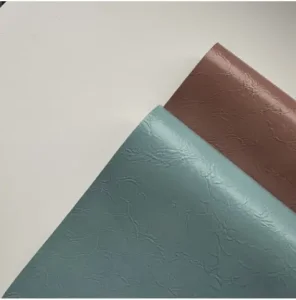
Industrial Grade Bio-Based Synthetic Leather 0177 for Trujillo Manufacturing
View Specification & Sample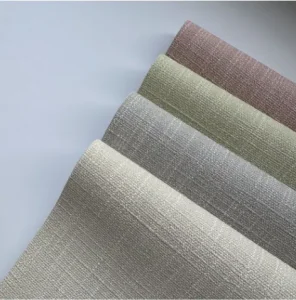
Reinforced Bio-Based Polyurethane 9384 for Andean Bus & Fleet Seating
View Specification & Sample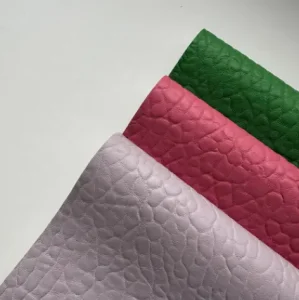
Premium Plant-Origin Leather 9293 for Lima Luxury Goods & Accessories
View Specification & SamplePeru’s Commercial & Manufacturing Shift toward Bio-Origin Materials
As Latin America accelerates decarbonization mandates and consumer consciousness surges, Peru stands at an industrial crossroads where sustainable bio-polymers define market leadership.
Trujillo Footwear Cluster Modernization
The footwear hub of El Porvenir in Trujillo produces a substantial portion of Peru's domestic shoes. Local manufacturers increasingly face rising costs of wet-blue tanning and severe water consumption penalties. Transitioning to USDA-certified biobased synthetic leather gives Trujillo shoemakers a high-yield, scratch-resistant alternative that bypasses traditional bovine tanning bottlenecks while delivering consistent roll thickness and flawless cutting yield.
Lima Gamarra Apparel & ESG Mandates
Lima's Emporio Comercial de Gamarra drives multi-million dollar apparel exports throughout the Andean Community (CAN) and Mercosur. Facing Peru’s national Circular Economy Action Plan (Hoja de Ruta hacia una Economía Circular en el Sector Industria), fashion houses are mandated to eliminate petroleum-heavy PVC. Water-based biobased synthetics fulfill this demand with zero toxic plasticizers, zero DMF, and compliance with the strictest EU REACH standards.
Andean Transit & Mining Heavy Durability
From high-altitude open-pit operations in Cerro de Pasco and Antamina to long-haul coach lines crossing the Andes, Peru requires materials that resist high UV degradation, sub-zero thermal cracking, and intense abrasion. Our technical biobased formulations incorporate advanced polyether-polyol backbones derived from non-food biomass, achieving up to 200,000 Martindale rubs without delamination or hardening at extreme altitudes.
Technical Comparison: Biobased Synthetics vs. Conventional Systems
Understanding molecular composition, life cycle carbon offsets, and mechanical metrics provides buyers with defensible data when bidding for municipal and international ESG contracts.
| Evaluation Parameter | JX.ECO Biobased PU (Plant-Derived) | Standard Petrochemical PU | Conventional PVC Fabric | Chrome-Tanned Bovine Leather |
|---|---|---|---|---|
| Raw Feedstock Base | Agricultural waste / Castor oil / Bio-polyols | 100% Fossil fuel crude / MDI & TDI | Petroleum / Vinyl chloride monomer | Animal hide with mineral chromium salts |
| Bio-Carbon Content (ASTM D6866) | 30% to 75%+ Verified | 0% Fossil only | 0% Fossil only | Natural animal protein matrix |
| Carbon Footprint (LCA kg CO₂/m²) | 4.2 - 6.8 | 14.5 - 19.2 | 22.0 - 28.5 | 65.0 - 110.0 |
| Cold-Crack Flexibility (-30°C) | Pass (>100,000 flexes) | Moderate (prone to hardening) | Fails (brittle fracture) | Good (requires fatliquoring) |
| Hydrolysis Resistance (Jungle Test) | 5 - 10 Years Grade Available | 2 - 5 Years | Indefinite (plasticizer migration risk) | Prone to fungal rot in high humidity |
| Peruvian Import Advantage | Preferential Tariff (China-Peru FTA) | Standard Tariff | Regulatory Disincentives | High customs quarantine friction |
Supply Chain Resilience: Direct-from-Campus Industrial Scale
Bridging the Pacific: How our 135,733 m² solar-powered manufacturing campus in Guangdong delivers unmatched throughput, zero batch-variation, and cost parity for Peruvian enterprises.
Fully Automated Dry & Wet Coating Precision
JiangXin New Material operates state-of-the-art continuous transfer coating lines with online beta-ray thickness sensors and closed-loop thermal polymerization. This eliminates edge-to-center caliper drift, ensuring that every 50-meter roll received at the Port of Callao possesses consistent tensile elasticity and flawless grain uniformity. Our automated color kitchens utilize computerized spectrophotometry to maintain Delta E < 0.5 across production batches.
Chancay Megaport Logistics & FTA Optimization
With the commissioning of the Chancay Megaport north of Lima, direct trans-Pacific maritime routes between China and Peru reduce maritime transit duration to approximately 23-28 days. Operating under the China-Peru Free Trade Agreement (FTA), our shipments come equipped with Certificate of Origin (Form F), clearing customs with preferential tariff treatment and shielding local partners from inflationary intermediate broker fees.
Engineered Application Scenarios Across Peruvian Industries
From coastal desert climates to freezing Andean mine shafts, explore how biobased synthetic leather solves specific mechanical and environmental challenges.
1. High-Performance Footwear
Peruvian footwear brands targeting export markets in North America and Europe require certified bio-content tags. Our biobased microfibers and vegan PU uppers deliver superior tear strength (>35 N/mm), soft drape, and excellent stitching retention, allowing Trujillo and Arequipa workshops to craft sneakers, casual loafers, and safety boots that fulfill international vegan audit requirements.
2. Interprovincial Bus & Light Rail Fleets
Peru's rugged topography subjects public transport seating to punishing friction and dramatic atmospheric shifts. Our flame-retardant (FMVSS 302 and UNECE R118 compliant) biobased upholstery features anti-graffiti surface lacquers, resistance to harsh disinfectant washes, and cold-flex stability that prevents surface crazing when navigating high passes such as Ticlio (4,818 m.a.s.l.).
3. Luxury Handbags & Artisan Fusion
Lima’s contemporary fashion designers frequently pair traditional Andean handwoven textiles (such as alpaca blends and aguayo motifs) with high-end structural leather. Our plant-derived bio-leathers offer an animal-free, odorless, and crack-proof framing medium that elevates artisan luxury collections for export to high-end boutiques in Paris, Tokyo, and New York.
Complete Biobased Material Range for Industrial Deployment
Explore our factory-direct articles available in tailored thicknesses (0.6mm to 1.8mm), custom surface grains, and verified biological content fractions.
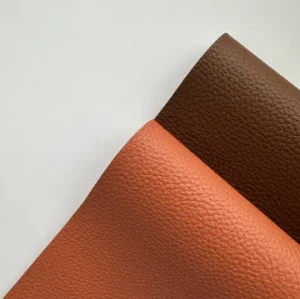
Custom Bio-Based Renewable Synthetic Leather 9109 for Automotive Seating
View Specification & Sample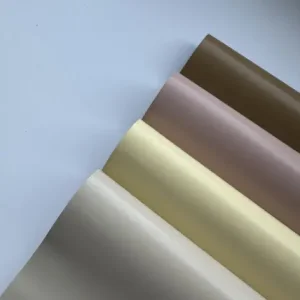
Tactile Biobased Synthetic Leather 2056 for Consumer Tech & Cases
View Specification & Sample
OEM Plant-Derived Bio-Based Synthetic Leather 2071 for Formal Footwear
View Specification & Sample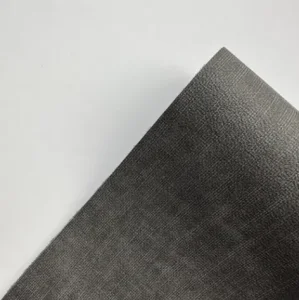
High-Quality Plant-Sourced Bio-Leather 9103 for Handbags & Luggage
View Specification & Sample
Custom Plant-Derived Bio-Based Synthetic Leather 9081 for Garments
View Specification & Sample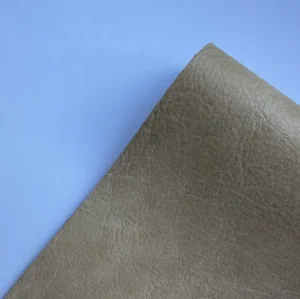
Wholesale Plant-Origin Renewable Leather 9271 for Commercial Furniture
View Specification & Sample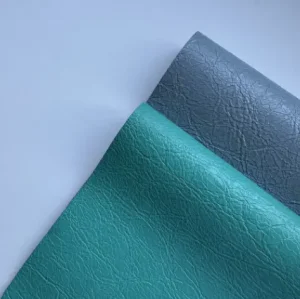
High-Quality Plant-Derived Synthetic Leather 9213 for Belts & Straps
View Specification & Sample
Plant-Derived Bio-Based Synthetic Leather 9020 for Safety Equipment
View Specification & SampleFrequently Asked Sourcing & Engineering Questions
Direct technical clarity for supply chain directors, industrial product engineers, and customs compliance officers in Peru.
How is biological carbon content analytically validated to avoid greenwashing?
Our biobased synthetic leather undergoes analytical radiocarbon dating under ASTM D6866 (Method B). This method measures the ratio of carbon-14 isotopes to carbon-12. Because fossil feedstocks have been buried for millions of years, their C-14 has completely decayed (zero percent modern carbon). In contrast, plant-derived polyols (harvested from non-food agricultural biomass, castor seed, or agricultural side-streams) contain modern atmospheric levels of C-14.
We provide third-party laboratory certificates (such as Beta Analytic reports) confirming the precise biobased percentage (e.g., 35%, 50%, or 75%) for every formulation. This technical certificate is recognized by the USDA BioPreferred Program and satisfies EU customs green procurement rules.
How does biobased leather withstand Peru's disparate microclimates (Lima humidity vs. Andean altitude)?
Coastal Lima experiences relative humidity consistently above 85-90%, inducing rapid hydrolytic degradation in sub-standard petrochemical PU. Conversely, Andean regions such as Cusco, Puno, and Junín experience intense solar ultraviolet irradiation and freezing nighttime temperatures.
To withstand these conditions, our polyols utilize tailored polycarbonate and polyether co-polymer backbones rather than standard polyester polyols. Our technical grades achieve Grade 4-5 in the Jungle Test (10 weeks at 70°C and 95% RH, equivalent to 8+ years real-life hydrolysis resistance) and remain flexible down to -30°C without micro-fracturing or stiffening.
What are the customs documentation and tariff implications under the China-Peru FTA?
Under the bilateral Free Trade Agreement between China and Peru, products classified under HS Chapter 59 (textile fabrics coated with polyurethane) qualify for preferential or zero tariff rates, provided they are accompanied by a validated Certificate of Origin Form F issued by Chinese customs authorities.
JiangXin New Material provides complete commercial export kits: Form F, detailed Commercial Invoices, Packing Lists with roll-by-roll gross/net weight breakdowns, and complete Safety Data Sheets (SDS) in compliance with SUNAT customs inspection protocols at Callao and Chancay ports.
What are the Minimum Order Quantities (MOQ) and lead times for customized embossing in Peru?
For catalog stock references, our MOQ is as low as 300 to 500 meters per color/grain. For bespoke formulations (tailoring bio-carbon percentage, exact RAL/Pantone color match, custom grain release paper, or specialized backings like recycled microfiber or organic cotton), our standard bulk MOQ is 1,000 meters per article.
Lab sample strike-offs and hand-swatches are dispatched via DHL/FedEx within 5 to 7 working days. Bulk production takes approximately 15 to 20 days upon master swatch approval, ensuring prompt delivery to oceanic freight dispatch.
Can biobased polyurethane comply with flame retardancy standards for Peruvian public transport?
Yes. We formulate halogen-free, antimony-free flame retardant finishes directly integrated into the skin and intermediate cellular layers of the biobased synthetic leather. Our materials meet FMVSS 302, UNECE R118 (Annex 6 & 8), and BS 5852 Crib 5 flammability specifications.
Crucially, because our flame retardants avoid toxic halogenated compounds, they emit significantly lower smoke density and zero corrosive hydrogen halides in the event of combustion, making them suitable for subterranean mining shuttles and interurban bus networks operating throughout Peru.