
Industrial-Grade Biobased & Sustainable Substrates (Series I)
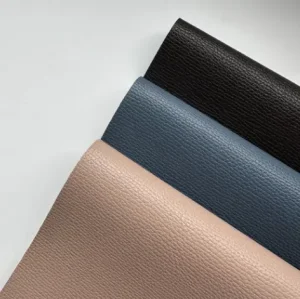
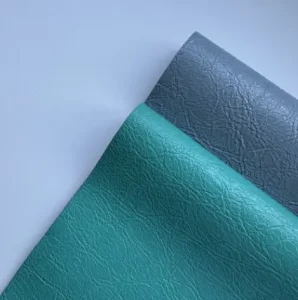
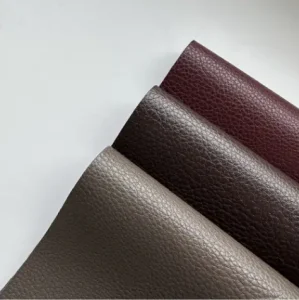
Certified renewable PU formulations engineered for seamless drop-in deployment across demanding footwear, luxury leathergoods, and technical interiors.

Global Enterprise Procurement Drivers for Plant-Based Leather
A systemic shift driven by regulatory carbon taxation, corporate ESG accountability, and consumer market readiness is rewriting raw material specifications globally.
Scope 3 Emissions & CBAM
Cross-border border tax mechanisms and rigorous Scope 3 emissions reporting mandate certified fossil displacement. Conventional solvent-borne PU yields 4.2 kg to 6.8 kg CO₂eq/m², whereas plant-derived coatings reduce cradle-to-gate impact by up to 58%.
Brand Differentiation & Consumer Willingness
Consumers in the EU, North America, and APAC demand authentic cruelty-free credentials without the plasticky feel of cheap PVC. Certified agricultural-residue polyurethane allows premium fashion, luxury automotive, and performance footwear houses to secure margins while protecting sustainability indices.
Chemical Elimination Directives
Stricter enforcement of SVHC (Substances of Very High Concern) under EU REACH and global ZDHC protocols is phasing out N,N-Dimethylformamide (DMFa), ortho-phthalates, and hazardous volatile organic compounds (VOCs), driving transitions to water-borne and solvent-free extrusion lines.
Macro Industry Solutions: Bridging Chemistry to Commercialization
Supplying multinational brands requires more than raw rolls. We implement an end-to-end framework resolving chemical synthesis, substrate structural integrity, and multi-region supply security.
Agricultural Upcycling & Polyol Chemistry
We synthesize bio-succinic acid, vegetable oil polyols, and cellulose matrices sourced from non-food agricultural side-streams (corn starch, castor seed, apple residue). By replacing petroleum-based methylenediphenyl diisocyanate (MDI) formulations with biogenic carbon backbones, we achieve renewable carbon fractions verified via ASTM D6866 radiocarbon testing.
Dual-Layer Mechanical Balance
A major pitfall of early bio-based leathers was layer delamination and low flex-fatigue. Our technical team pairs specialized water-borne polyurethane (WPU) skin layers with GRS/RCS-certified recycled post-consumer polyester (rPET) knit or organic woven cotton backings, ensuring peeling strengths exceed 2.5 kg/3cm.
High-Volume Roll Consistency
Industrial scaling requires reliable width uniformity, zero roll-to-roll batch variation, and tight surface tension control for die-cutting efficiency. Our facility utilizes automated optical inspection (AOI) running alongside multi-roller coating heads to guarantee yield rates above 98.5% across thousands of meters.
Material Performance Matrix: Plant-Based PU vs. Industry Baselines
Direct comparative benchmarks demonstrating that contemporary plant-based leathers meet or exceed heavy-duty automotive, footwear flex, and luxury luggage benchmarks.
| Evaluation Parameter | Test Methodology | JX.ECO Plant-Based PU | Standard Petroleum PU | Traditional Chrome Leather |
|---|---|---|---|---|
| Biobased Carbon Share | ASTM D6866-22 Method B | 30% to 75% Biogenic | 0% (100% Fossil Derived) | 0% (Organic Protein Derived) |
| Bally Flex Resistance (Dry) | ISO 5402-1 / SATRA TM55 | > 150,000 Cycles (No Cracking) | 80,000 - 100,000 Cycles | 50,000 - 100,000 Cycles |
| Martindale Abrasion | ISO 12947-2 (12kPa load) | > 50,000 Revs (No Breakdown) | 30,000 - 40,000 Revs | 25,000 - 45,000 Revs |
| Hydrolysis Resistance | Jungle Test (70°C, 95% RH) | 7 to 10 Weeks (Class 5) | 3 to 5 Weeks | Poor (Prone to rotting) |
| DMFa & Restricted Solvents | EN ISO 18218 / GC-MS | Undetectable (< 2ppm) | 10 - 300 ppm (Solvent line) | Not Applicable (Chromium VI risk) |
| VOC Emissions & Odor | VDA 270 (Thermal Desorption) | Grade 1.5 - 2.0 (Ultra-Low) | Grade 3.5 - 4.5 (Pungent) | Grade 3.0 - 4.0 (Tannin aroma) |
Technical Roadmap & Future Outlook: Beyond 2026
Mapping the next five years of macromolecular innovation to take vegan and bio-based synthetic substrates toward total circularity and true mono-material recycling.
Phase I: 85%+ Plant Carbon
Optimizing enzyme-assisted polysaccharide polyols and lignin derivatives to raise verified ASTM D6866 bio-carbon content from 40% to over 85%, eliminating residual petrochemical components without sacrificing hydrolysis ratings.
Phase II: Mono-Material Polyurethane
Engineering 100% circular articles where both the decorative skin and the non-woven structural base utilize matching aliphatic bio-PU chains, enabling infinite mechanical and chemical closed-loop recycling without delamination steps.
Phase III: CCU Direct Synthesis
Integrating Carbon Capture and Utilization (CCU) feedstocks to directly transform point-source flue-gas CO₂ emissions into low-molecular-weight polycarbonate polyols, transitioning the material footprint from low-carbon into true carbon-negative supply.
Phase IV: Industrial Compostability
Deploying tunable biological cleavage sites within polyaddition urethane crosslinks. At end-of-life, the spent leather decomposes in commercial composting environments (ISO 14855) within 180 days, leaving non-toxic biogenic matter.
A 135,733 m² Clean-Tech Industrial Engine in Guangdong
Established on June 2, 2017, Yingde City JiangXin New Material Co., Ltd. (JX.ECO) pairs petrochemical rigor with forward-thinking clean-energy manufacturing infrastructure.
Localized Support, Traceability & Auditable Compliance
Multinational procurement demands frictionless verification. Every shipping lot carries verifiable documentation aligned with global import regimes and environmental frameworks.
Chain of Custody (RCS & USDA)
Every shipment under our Recycled Claim Standard (RCS) program is backed by official Transaction Certificates (TCs) generated through independent certifiers. Bio-based lots are documented with certified carbon-14 fractionation reports, giving brand sustainability officers ironclad claims for packaging and public disclosures.
Rigorous Chemical Safety (REACH / RoHS)
We provide complete material testing reports matching EU REACH Annex XVII, California Proposition 65, RoHS 2.0, and 6P Phthalate-free mandates. Our plant-derived matrices are non-toxic, skin-safe (OEKO-TEX Standard 100 Class I compliant), and free from organotin stabilizers or halogenated flame retardants.
Social Governance & Factory Audits
JiangXin operates under amfori BSCI social responsibility standards and ISO 9001 / ISO 14001 certified process management. Brands benefit from Higg FEM (Facility Environmental Module) reporting, verifying responsible water treatment, energy recovery loops, and safe working conditions across our campus.
Frequently Asked Questions: Technical & Commercial Answers
Direct answers to the regulatory, mechanical, and logistical questions enterprise materials teams evaluate before sampling and commercial purchase.
How does plant-based leather differ chemically from conventional PU and PVC?
Traditional PU utilizes polyols and isocyanates derived 100% from refined petroleum, whereas PVC depends on synthetic vinyl chloride plastisols stabilized with heavy phthalate plasticizers. JX.ECO plant-based leather replaces fossil polyols with biogenic polyols synthesized from agricultural residues and renewable plant oils. The resulting molecular network exhibits identical or superior flexibility and longevity while dramatically lowering cradle-to-gate carbon intensity and avoiding restricted phthalates entirely.
How is the biobased content validated and certified for marketing claims?
Biobased content is quantitatively measured via radiocarbon analysis under ASTM D6866 (Standard Test Methods for Determining Biobased Content of Solid, Liquid, and Gaseous Samples using Radiocarbon Analysis). This distinguishes modern bio-carbon (carbon-14 isotopes) from fossil carbon. Our formulations deliver bio-based contents verified between 30% and 75% depending on customer tech-pack requirements, aligning directly with the USDA BioPreferred Program and European EN 16785-1 standards.
Can your plant-based materials withstand industrial footwear lasting and flex stresses?
Yes. JX.ECO engineering specifically optimizes elongation, tensile strength, and flexural fatigue. Our premium plant-based articles undergo rigorous testing: Bally flex endurance exceeds 150,000 cycles without micro-cracking, Martindale abrasion resistance surpasses 50,000 revolutions at 12 kPa, and tensile strength exceeds 350 N/3cm. This ensures compatibility with toe-lasting, heel-forming, and high-frequency welding machines without puckering, tearing, or finish blistering.
What is the standard Minimum Order Quantity (MOQ) and sample lead time?
For sampling, we ship yardage or A4 swatch catalogs within 48 to 72 hours from our active inventory. Custom color matching (Pantone/physical target) and specialized emboss texture replication typically require 5 to 7 business days for laboratory dip approval. For bulk production runs, our standard baseline MOQ is 500 to 1,000 linear meters per color and grain, supported by a daily campus output that can easily scale for multi-container enterprise rollouts.
How does JX.ECO manage solvent compliance, DMFa limits, and low-VOC targets?
Our modern Yingde production campus integrates clean-tech solvent-free extrusion and advanced water-borne polyurethane (WPU) coating technologies. Unlike obsolete dry-process factories, our formulations require no hazardous organic solvents such as Dimethylformamide (DMFa), Toluene, or MEK. Routine third-party GC-MS screenings consistently confirm DMFa levels below 2 ppm (well below the stringent EU REACH threshold of 5 ppm), fulfilling the cleanest automotive interior (VDA 270) and skin-contact footwear criteria.
Can you provide combined biobased surface coatings with recycled backings?
Absolutely. Hybrid sustainable substrates represent our fastest-growing commercial product line. We frequently combine a 30%–70% plant-derived bio-PU topcoat with a 100% Recycled Claim Standard (RCS) or Global Recycled Standard (GRS) certified post-consumer recycled (rPET) microfiber or fleece base. This engineering approach optimizes both Scope 3 fossil displacement and post-consumer waste diversion, maximizing the defensible ESG score of the finished commercial product.
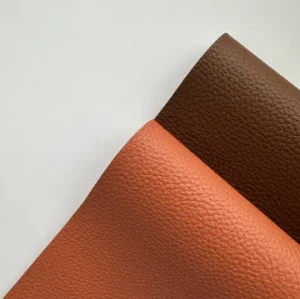
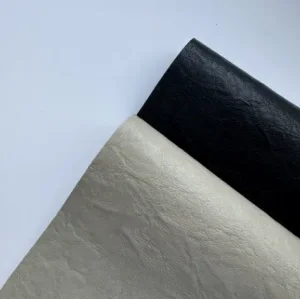
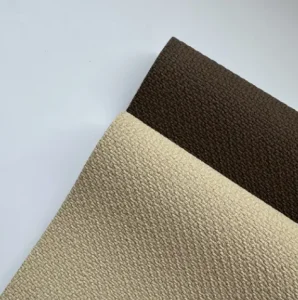
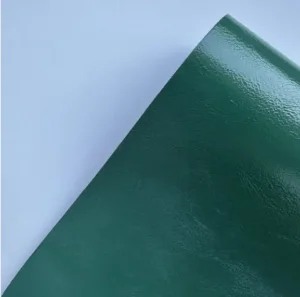
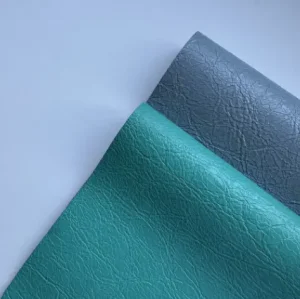
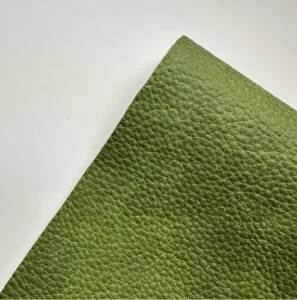
Industrial-Grade Biobased & Sustainable Substrates (Series II)
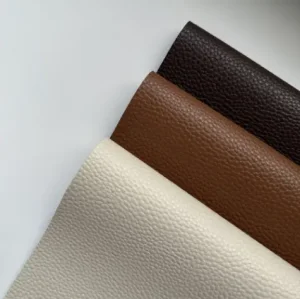
High-yield, customized aesthetic grains and high-abrasion specifications matched to leading global tech packs and production schedules.

Accelerate Your Decarbonization Roadmap
Connect directly with our macromolecular formulation engineers and global export directors. Receive technical swatches, ASTM D6866 radiocarbon validation reports, and tailor-made quotes matched to your specific tech pack.
Request Swatch Book & Engineering Consultation