
Featured Sustainable Synthetic Leather Specifications
High-performance sustainable PU formulations certified under international carbon accounting standards, engineered for extreme flexural resilience and luxury haptic response.
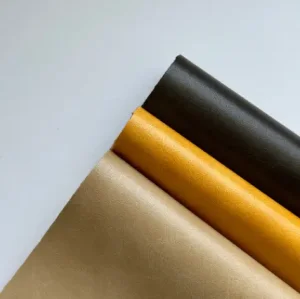
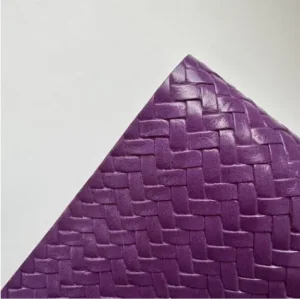
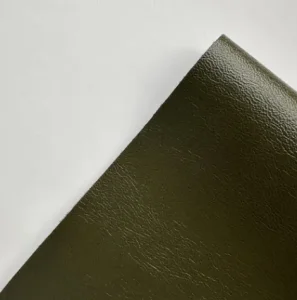
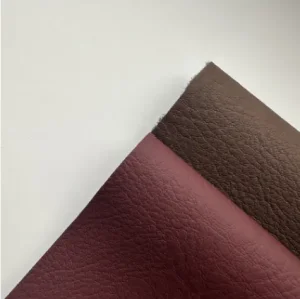
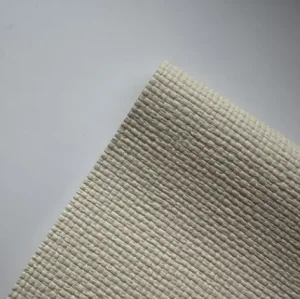
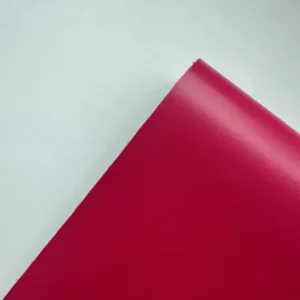
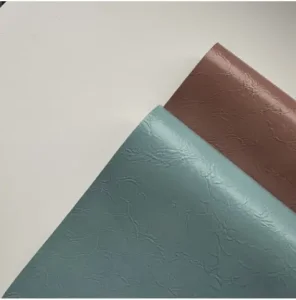
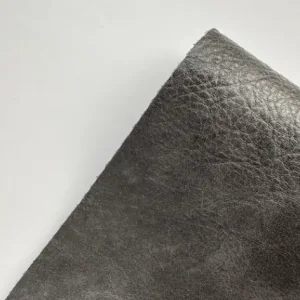
Macro Procurement Demands in the Post-Petrochemical Leather Era
How Fortune 500 purchasing directors, automotive interior engineers, and multinational luxury houses navigate Scope 3 emissions, CSRD disclosure, and chemical safety mandates.
Scope 3 Emission Mitigations
With the European Corporate Sustainability Due Diligence Directive (CSDDD) and mandatory Scope 3 Greenhouse Gas Protocol audits, enterprises can no longer rely on legacy fossil PU or chromium-tanned animal hides. Transitioning to USDA BioPreferred and RCS post-consumer circular carriers directly slashes upstream carbon intensity by up to 68% per square meter.
Zero-Solvent Regulatory Mandates
Global chemical frameworks including EU REACH Annex XVII, California Proposition 65, and restricted substance lists (ZDHC MRSL Level 3) heavily penalize residual DMFa (Dimethylformamide), toluene, and toxic plasticizers. OEM procurement requires solvent-free hot-melt extrusion or 100% waterborne polyurethane dispersions that eliminate volatile organic compound emissions entirely.
Rigorous Chain-of-Custody Traceability
Greenwashing risks have led institutional buyers to disqualify unverified sustainability assertions. Sourcing contracts require formal Recycled Claim Standard (RCS) or Global Recycled Standard (GRS) Transaction Certificates (TCs), paired with ASTM D6866 radiocarbon analytical dating to objectively confirm biogenic carbon fractions in plant-based synthetic skins.
Material Architecture: Sustainable Alternatives vs. Legacy Materials
Empirical comparisons spanning petrochemical PU, PVC, bovine leather, and next-generation bio-based/recycled composite structures.
| Performance & ESG Vector | Bio-Based PU (JX.ECO) | RCS Recycled PU (JX.ECO) | Conventional Dry-PU | Traditional PVC Skin | Bovine Animal Leather |
|---|---|---|---|---|---|
| Primary Carbon Origin | Renewable Plant Lipids (30-75%) | Post-Consumer rPET Matrix | 100% Virgin Fossil Fuel | Fossil Hydrocarbons + Cl | Cattle Grazing & Tannery |
| VOC & Solvent Vector | Waterborne / Solvent-Free (0 VOC) | Solvent-Free Hot-Melt System | DMF / MEK / Toluene | Ortho-Phthalates / Plasticizers | Formaldehyde / Chromium VI |
| Hydrolysis Resistance | Jungle Test 5–10 Years Validated | Jungle Test 5–8 Years Validated | 1–3 Years Average Failure | Moderate (Plasticizer Migration) | High (Risk of Putrefaction/Stiffening) |
| Embodied Water Footprint | < 18 Liters / Linear Meter | < 12 Liters / Linear Meter | ~65 Liters / Meter | ~80 Liters / Meter | > 17,000 Liters / Equivalent Mass |
| Cold Crack Resistance | -30°C Dynamic Flex (ASTM D2097) | -25°C Dynamic Flex | -10°C Embrittlement | -5°C Immediate Fracture | -20°C (Surface finish prone to crack) |
| Compliance Readiness | REACH, RoHS, USDA BioPreferred | RCS 2.0, GRS 4.0, OEKO-TEX 100 | Frequent REACH SVHC Flags | Restricted (Toxic Phthalates) | LWG Audited / Heavy Metals Risk |
Technological Roadmap: Molecular Formulation & Closed-Loop Engineering
From botanical polyol synthesis to solventless polymer reaction chambers, discover our multi-generational R&D milestones.
Post-Consumer Circularity
Integration of 100% GRS/RCS certified microfibers derived from discarded ocean-bound and consumer beverage rPET. Multi-ply carded micro-filament fleece provides isotropic tensile strength matching whole-hide cross-grain split leather.
Bio-Synthetic Condensation
Replacing petroleum succinic acids with non-edible botanical polyols derived from castor seeds, corn starch waste, and agricultural by-products. Molecular cross-linking guarantees non-yellowing UV resistance (Grade 4.5 Xenon Arc).
100% Solid Solidification
Pioneering two-component reactive polyurethane systems where isocyanate and resin pre-polymers react instantaneously without solvent carriers. Completely eliminates solvent evaporation ovens, cutting plant process energy demands by 52%.
Enzymatic End-of-Life Degrade
Formulating next-gen polyester-polyurethane segments engineered to selectively break down under municipal industrial composting conditions (ISO 14855 / ASTM D5338), eliminating synthetic polymer landfill persistence.
Engineering Solutions Tailored to High-Stress Applications
Every application profile faces unique mechanical and chemical friction. We calibrate custom grain embossments, backer stretch ratios, and top-coat barrier resins to meet strict tier specifications.
Automotive Interiors & EV Cabins
Engineered to pass strict low-fogging tests (DIN 75201 G/B), flame retardancy (FMVSS 302, ISO 3795), and prolonged xenon arc weathering (SAE J2412). Perfect for lightweight seat covers, dashboards, and tactile armrests in electric vehicles.
Athletic Footwear & Lifestyle Sneaker Uppers
Superior flexural fatigue endurance exceeding 150,000 cycles on Bally Flexometers at room temperature and 50,000 cycles at -20°C. Formulated with high-rebound backing fabrics for rapid thermoforming, high-frequency embossing, and die-cutting.
Luxury Handbags, Luggage & Leather Goods
Ultra-luxurious tactile grain matching calfskin and lamb nappa without animal derived content. Unsurpassed edge-paint adhesion, skiving stability, and high tear-propagation resistance (> 45 N/mm, ISO 3377-2) prevent seam pullouts.
Global Compliance Systems & Localized Regulatory Assurance
How our factory guarantees friction-free market clearance across Europe, North America, Japan, and emerging retail economies.
European Union Reach & RoHS Clearance
Materials are systematically assayed for over 235 substances on the ECHA Candidate List of Substances of Very High Concern (SVHC). We ensure zero added short-chain chlorinated paraffins (SCCPs), polycyclic aromatic hydrocarbons (PAHs), and organic tin compounds.
North American Safety & Prop 65 Compliance
Formulated to satisfy strict limits on ortho-phthalates (< 50 ppm for DEHP, DBP, BBP, DINP, DIDP, DnOP) matching CPSIA standards for youth and children’s goods, completely bypassing California Proposition 65 warning label friction.
Higg FEM & amfori BSCI Social Verification
Transparency extends beyond the roll to the factory floor. Our 135,733 m² Yingde campus is routinely audited via amfori BSCI social compliance protocols and the Higg Facility Environmental Module (FEM), verifying safe fair work and ethical governance.
Clean Production Architecture: Yingde City JiangXin New Material Co., Ltd.
Established on June 2, 2017, JX.ECO represents the next paradigm in low-carbon chemical engineering.
4.68 MW Solar Photovoltaic Grid
Spanning the roofs of our modern glass workshops, our on-site photovoltaic grid generates millions of kilowatt-hours of clean electricity per year, drastically reducing reliance on municipal coal power and offsetting the Scope 2 emissions of every production run.
Thermal Energy Recovery Systems
Specially patented waste-heat recovery scrubbers capture thermal energy generated across high-temperature drying ovens and reactive calendering cylinders. Recycled hot air is channeled back into preheating cycles, minimizing raw gas fuel consumption.
Zero-Liquid Discharge Effluent Treatment
Our on-campus biological water treatment station processes process wastewater through membrane bioreactor (MBR) and reverse-osmosis filtration. Over 85% of industrial water is re-circulated within closed cooling loops, protecting surrounding river ecosystems.
Five-Stage OEM Strategic Sourcing Workflow
From digital tech-pack parameter matching to final ISO container stuffing, our disciplined milestone structure ensures zero batch variance.
Engineering Intake
Analysis of brand tech packs, physical thickness specifications (0.4mm to 3.0mm), target elongation ratios, and end-market compliance RSLs.
Rapid Prototype Lab
Swatch casting within 72 hours. Custom color matching via spectrophotometers (Delta E < 0.6) and precision grain roller micro-replication.
Third-Party Verification
Mechanical batch validation (Taber Abrasion, Bally Flex, Martindale) and chemical screening with certified lab pass sheets prior to scale approval.
Automated Mass Run
Production along automated computer-controlled coating and drying lines with continuous laser thickness gauges and digital surface anomaly detection.
Frequently Asked Technical & Sourcing Questions
Expert responses addressing chemical mechanics, minimum order volumes, chain-of-custody documentation, and durability testing.
How does JiangXin quantify and verify the bio-based content in plant-derived leather?
Bio-based content represents the exact percentage of modern biogenic carbon atoms versus non-renewable petrochemical carbon. JiangXin verifies all bio-based series via rigorous ASTM D6866 radiocarbon (Carbon-14) isotopic analysis. This methodology mirrors USDA BioPreferred certification protocols, allowing tier-1 brands to publish verifiable bio-content percentages on legal hangtags and CSRD ESG reports.
What is the official procedure for issuing RCS / GRS Transaction Certificates (TCs)?
As an accredited Recycled Claim Standard (RCS) facility, JiangXin maintains a strictly audited chain of custody through Textile Exchange authorized certification bodies. Upon issuance of a production purchase order, raw post-consumer input lots are dedicated and tracked. After shipment, we apply for and deliver official Transaction Certificates (TCs) identifying exact gross/net weights and certified percentages to support customer customs clearance and brand auditing.
How does sustainable synthetic leather achieve multi-year hydrolysis resistance?
Traditional PU leather fails through ester bond scission under heat and moisture. JiangXin solves this by integrating high-molecular polycarbonate-based polyols and polyether-polyol hybrids. In accelerated humidity chambers (Jungle Test at 70°C and 95% relative humidity), our engineered leather withstands 5 to 10 weeks of continuous exposure without delamination or surface tackiness, correlating to 5–10 years of real-world ambient usage.
What are standard production MOQs and sample turnaround timelines?
For custom engineering and bespoke colorways, standard production minimums are 500 linear meters per color/grain, allowing flexible multi-SKU seasonal capsule development. Catalog stock base articles can be dispatched immediately. Physical lab dip swatches and hand feel strike-offs require 3–5 working days, while complete roll prototyping for fit tests ships within 7–10 days.
Can materials pass strict automotive VOC and fogging requirements?
Yes. Utilizing 100% solvent-free casting lines eliminates aromatic amine solvents, residual dimethylformamide (DMFa), and volatile ketone carriers. Our automotive interior grade articles easily satisfy DIN 75201 gravimetric and photometric fogging tests (G-value < 2 mg), alongside VDA 270 olfactory evaluations and VDA 277 total carbon emission thresholds.
How does synthetic leather yield improve cutting efficiency over real animal leather?
Raw animal hides exhibit irregular shapes, neck wrinkles, branding marks, and insect bites, yielding an average usable area of only 60–70% and requiring labor-intensive manual nesting. JiangXin synthetic leather is manufactured in uniform rolls of 1.37 meters (54 inches) effective width, achieving cutting yields exceeding 95% on automated high-speed CNC reciprocating and laser cutters.
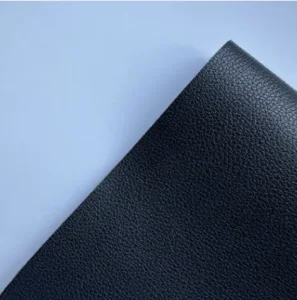
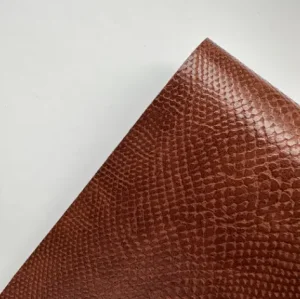
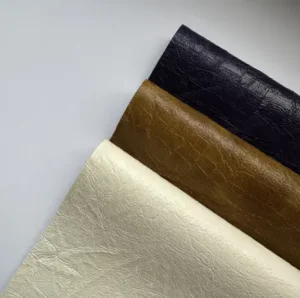
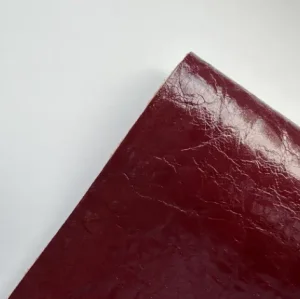
Traceable Recycled & Plant-Based Vegan Formulations
Certified circular leather alternatives designed for high-abrasion apparel, accessories, structural bags, and heavy-duty contract upholstery.
Initiate Material Co-Engineering & Request Certified Swatches
Partner with Yingde City JiangXin New Material Co., Ltd. (JX.ECO) to safeguard your environmental governance, de-risk Scope 3 disclosures, and access clean-tech synthetic leather capacity engineered for world-class tier brands.
Request Technical Spec Sheet & OEM Swatch Hanger Pack