
Primary Post-Consumer & Bio-Based Synthetic Leather Reference Articles
Direct factory-calibrated engineering specifications engineered from post-consumer recycled substrates and renewable bio-polyol layers for premium footwear, luggage, apparel, and automotive seating.
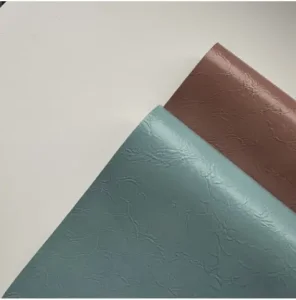
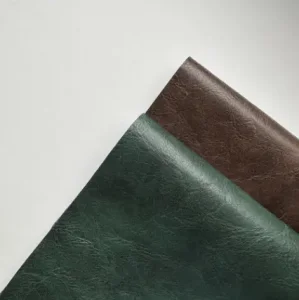
High-Quality Sustainable Recycled Synthetic Leather with Official RCS Certification-9240
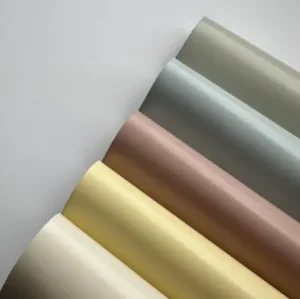
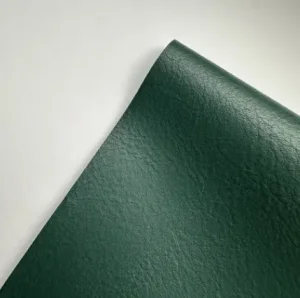
The Industrial Transition to Post-Consumer Recycled (PCR) Leather
Beyond rudimentary pre-consumer waste recovery: how advanced chemical depolymerization, purified post-consumer PET fleece, and circular polyurethane composites are reshaping the global synthetics ecosystem.
LCA Carbon Footprint Reductions
Traditional solvent-borne PU leather produces up to 15.8 kg of CO2e per linear meter. JiangXin's verified PCR leather matrix incorporates up to 60% post-consumer recycled rPET knit substrates and solvent-free PU skin resins, reducing Scope 3 upstream cradle-to-gate greenhouse gas emissions by up to 48.7% according to ISO 14044 LCA metrics.
Pre-Consumer vs. Post-Consumer Integrity
While industry standard "recycled" leather frequently relies on factory cutting scraps (PIR), global ESG auditors mandate Post-Consumer Recycled (PCR) feedstocks sourced directly from municipal polymer streams, ocean-bound plastic bottles, and discarded post-consumer textiles, requiring rigorous chemical scrubbing to eliminate legacy plasticizers and heavy metals.
Digital Product Passports (DPP) Ready
Under the European Union Ecodesign for Sustainable Products Regulation (ESPR), materials imported into Europe require complete chain-of-custody data. Our facility maps every production roll through batch-specific Recycled Claim Standard (RCS) transaction certificates and serialized QR integration, enabling frictionless digital compliance for multi-tier brands.
Enterprise Procurement Matrix: Overcoming the Physical Trade-Off
How tier-one automotive, athletic footwear, and luxury goods OEMs specify post-consumer recycled leather without sacrificing mechanical elongation, flex fatigue, or hydrolytic resistance.
| Performance Criterion | Legacy Recycled Synthetics | JiangXin (JX.ECO) PCR Engineering Spec | Standard Test Validation Protocol |
|---|---|---|---|
| Hydrolysis Resistance | Delamination at 3–5 weeks (Jungle Test) | 10+ Weeks Tropical Jungle Chamber (70°C, 95% RH) | ISO 1419 Method C / ASTM D3690 |
| Martindale Abrasion | 20,000–30,000 Cycles before fiber breakthrough | 100,000+ Cycles (Dry) / 50,000 Cycles (Wet) | ISO 12947-2 / ASTM D4966 (12kPa load) |
| Bally Flex Resistance | Cracking at -10°C after 30,000 cycles | Zero cracking at 150,000 cycles (Room Temp) / 50,000 cycles (-20°C) | ISO 5402-1 / DIN 53351 Cold Bend |
| Substrate Integrity | Uneven tensile stretch from shred blends | Continuous filament PCR rPET microfiber / micro-terry | ISO 13934-1 Tensile Strength ≥ 450 N/5cm |
| VOC Emissions | Residual DMF > 50 ppm, high odor scores | Solvent-Free Waterborne PU, DMF < 2 ppm (ND) | VDA 278 / ISO 16000 Thermal Desorption |
| Traceability Auditing | Self-declared vendor certificates | Third-party audited RCS 2.0 / GRS Transaction Certificates | Textile Exchange Chain of Custody System |
Custom Embossing & Grain Retention
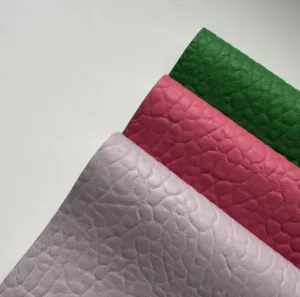
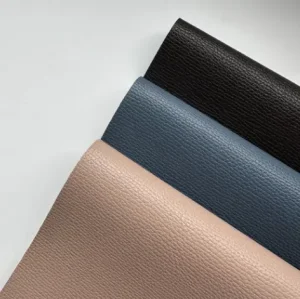
Unlike inferior bonded leathers that lose grain definition under high-heat lasting or vacuum thermoforming, JiangXin's crosslinked polyurethane skin layers feature superior thermal elasticity. From fine-grain nappa to distinct toothpick textures and deep pebble milling, our grain formulations resist gloss migration and flatten deformation under 120°C manufacturing cycles.
Advanced Flame Retardancy (FR) Integration
Global contracts for automotive interiors and commercial upholstery require rigorous flame-retardant performance without toxic halogenated compounds. Our technical lab incorporates phosphorus-nitrogen reactive FR polyols directly into the polyurethane backbone, achieving compliance with British Standard BS 5852 Crib 5 and California Technical Bulletin CAL 133 without migration or surface bloom.
State-of-the-Art Clean-Tech Manufacturing Campus: Yingde, Guangdong
Established on June 2, 2017, Yingde City JiangXin New Material Co., Ltd. (JX.ECO) represents the benchmark for modernized synthetic leather production, integrating solar arrays, zero-VOC lines, and industrial water reclamation.
135,733 m² Regulated Campus
Engineered in full compliance with modern chemical-industrial and structural safety regulations. Our facility features floor-to-ceiling tempered glass workshop bays providing high natural daylight, reducing energy demand, and elevating work safety standards for our technical personnel.
4.68 MW Photovoltaic Energy
Our campus roof houses a massive 4.68 megawatt solar grid, producing millions of kilowatt-hours annually. This clean energy powers our dry-process and solvent-free coating lines, slashing grid dependency and providing verifiable Scope 2 carbon offsets for every batch produced.
Thermal Recovery & Closed Wastewater
Equipped with computerized heat-recovery ventilators that capture hot exhaust from curing ovens, recirculating heat energy back into preheating cycles. An on-site biological sewage treatment facility recycles industrial wash water in an endless loop, eliminating environmental discharge.
Worldwide Compliance, RSL Verification & Export Certification
Navigating complex international environmental law: how JiangXin secures zero-clearance friction for brands importing into the European Union, North America, Japan, and the United Kingdom.
EU REACH SVHC Compliance
Strict formulation auditing ensures all articles test negative for over 230+ Substances of Very High Concern (SVHC) under European Regulation (EC) No 1907/2006, including DMFa, organotin compounds, short-chain chlorinated paraffins (SCCPs), and PAH compounds.
Phthalate-Free & 6P Protocols
Formulated without hazardous ortho-phthalate plasticizers (DEHP, DBP, BBP, DINP, DIDP, DnOP). Certified compliant with the US Consumer Product Safety Improvement Act (CPSIA) Section 108 and California Proposition 65 total phthalate concentration limits.
OEKO-TEX & Higg Index Certified
Production validated by amfori BSCI ethical working condition standards and annual Higg Facility Environmental Module (FEM) verifications. Materials comply with OEKO-TEX Standard 100 Class I (safe for infants and skin contact products).
RCS & USDA BioPreferred Traceability
Traceable through Textile Exchange Recycled Claim Standard (RCS 2.0). Bio-based articles verified via ASTM D6866 carbon-14 isotope radiocarbon testing under the USDA BioPreferred Program, guaranteeing genuine non-fossil content.
Technological Roadmap: The Path to Infinite Circularity
JiangXin's strategic research and development initiatives bridging high-performance synthetic chemistry with closed-loop enzymatic polymer recovery.
100% Solvent-Free & Waterborne PU Transition
Elimination of Dimethylformamide (DMF) across all standard product catalogs. Universal integration of GRS-certified post-consumer rPET backings across footwear, accessory, and furniture lines, locking in a minimum 30–50% verified recycled content matrix.
Enzymatic Depolymerization & Agricultural Waste Feedstocks
Industrialization of plant-derived polyols sourced from non-food agricultural byproducts (corn stover, sugarcane bagasse, castor oil) coupled with chemically depolymerized post-consumer polyurethane. Target: reaching 75% combined bio-based and PCR content while preserving 10-week hydrolysis stability.
Mono-Material Recyclable Leather Assemblies
Engineering single-polymer synthetic leathers (100% TPU / 100% Polyester mono-structures) where the coating and backing fuse without cross-contamination. This breakthrough allows post-consumer leather goods to be shredded and directly remelted into virgin-grade filaments without mechanical or chemical delamination.
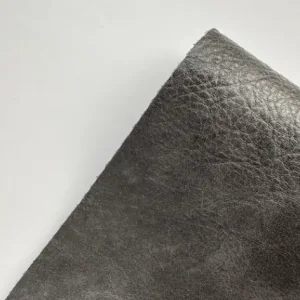
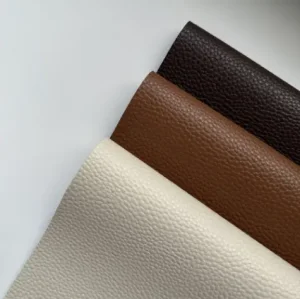
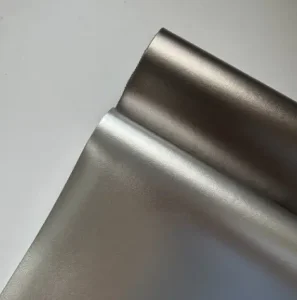
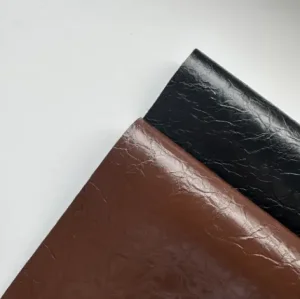
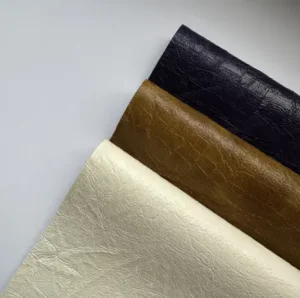
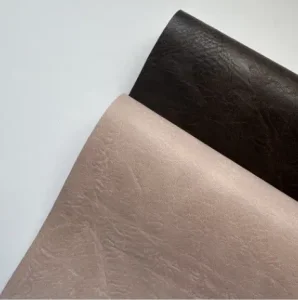
Specialty Post-Consumer Recycled & High-End Synthetic Leather
Engineered for precise hand feel, dimensional stability, and harsh wear cycles. Review the full specifications below and request OEM tech pack swatch samples directly from our engineering team.


Frequently Asked Questions for Enterprise Sourcing Directors
Clear technical answers addressing testing protocols, minimum order quantities, certification chain-of-custody, and custom tech-pack development.