
Core RCS-Certified Materials for Argentine Manufacturers
Engineered for Latin American footwear lines, fashion accessory workshops, and contract automotive tiers requiring immediate laboratory-verified recycled content.
The Argentine Industrial Landscape: Navigating Transition from Bovine to Recycled Polymers
Strategic insights into the commercial pressures, environmental frameworks, and supply chain shifts reshaping South America's second-largest economy.
Tannery Transition & Water Stress
Historically dominated by cattle processing along the Matanza-Riachuelo basin and Santa Fe province, Argentine heavy industry is now facing unprecedented tightening of effluent discharge policies by ACUMAR and provincial environmental authorities. Traditional chrome-tanning operations are struggling with rising costs, toxic sludge penalties, and water depletion.
Consequently, progressive manufacturers across Greater Buenos Aires (Lanús, Avellaneda, San Martín) are aggressively integrating RCS-certified recycled synthetic leather (PU and microfibers) to eliminate toxic water run-off, fulfill ESG mandates, and cut unit production weights by up to 35% compared to heavy wet-blue hides.
Automotive OEM Decarbonization
Córdoba and Greater Buenos Aires host major international assembly plants (including Toyota in Zárate, Stellantis in El Palomar, Volkswagen in General Pacheco, and Renault in Santa Isabel). These multi-tier automotive hubs must meet corporate net-zero commitments and regional Mercosur environmental mandates.
Our RCS-certified synthetic substrates give Tier-1 and Tier-2 automotive interior converters (seat bolsters, door cards, instrument clusters, gear shift boots) verified recycled content from post-consumer PET bottles without forfeiting rigorous heat-aging, UV-resistance, and cold-crack thresholds.
Palermo Soho Vegan Luxury Boom
Buenos Aires represents Latin America’s epicenter of independent high fashion and artisanal accessories. Modern Argentinian consumers and design-led export labels based in Palermo, Recoleta, and San Telmo reject non-traceable petroleum faux leathers in favor of verified recycled, animal-free alternatives.
Brands targeting European and North American buyers demand official Transaction Certificates (TC) under RCS standards. Our materials provide the tactile supple drape of nappa leather combined with certified sustainability credentials that withstand strict greenwashing audits.
Chinese Mega-Factory Engineering: Scalable Precision for Global Importers
Yingde City JiangXin New Material Co., Ltd. (JX.ECO) bridges raw material chemistry and certified supply chain traceability across a 135,733 m² integrated campus.
Vertical Polymer & Backing Integration
Unlike secondary converters who merely purchase stock base fabrics and apply generic polyurethane skin coats, our Guangdong production base controls the entire value chain:
- Recycled Backing Production: Direct extrusion and knitting of post-consumer recycled PET (rPET) fibers, ultra-fine microfibers, and circular cotton blends.
- Low-VOC & Waterborne Formulations: In-house synthesis of water-based PU resin (DMFa-free, solvent-free) yielding zero hazardous aromatic amines.
- Custom Graining & Texturing: Over 1,200 roller embossing matrices (from smooth calf and classic pebble grain to high-tech carbon matrix and toothpick embossing).
Unbroken RCS Chain-of-Custody (CoC)
Procuring sustainable textiles internationally poses serious corporate compliance risks if certifications lack institutional oversight. JX.ECO operates strictly under Textile Exchange standards:
- RCS Scope Certificate (SC): Audited yearly by accredited third-party certification bodies, proving factory eligibility.
- Transaction Certificate (TC) Issuance: Every container arriving at Buenos Aires Port (Puerto Nuevo / Exolgan) or Zarate can be accompanied by an individual order-specific TC, documenting exact batch weight and verified recycled percentage.
- Full Input Traceability: Continuous mass-balance verification tracing polymer feedstock back to authenticated post-consumer recycling facilities.
Engineering Audit: Bovine Leather vs. Standard PU vs. JX.ECO RCS-Certified PU
Quantitative physical metrics and lifecycle data for industrial procurement engineers across Latin America.
| Performance Parameters | Argentine Bovine Leather | Conventional Petroleum PU | JX.ECO RCS-Certified Recycled PU |
|---|---|---|---|
| Post-Consumer Recycled Content | 0% (Primary Organic Byproduct) | 0% (Virgin Petrochemical Feedstock) | 20% to 100% Verified (RCS Standard) |
| Carbon Footprint (kg CO₂ eq / m²) | ~65.0 - 110.0 kg | ~14.5 - 18.2 kg | ~5.2 - 7.8 kg (Solar-Powered Plant) |
| Water Consumption per m² | > 12,000 Liters (Tanning & Rinsing) | ~350 Liters | < 45 Liters (Closed-Loop Water Treatment) |
| Bally Flex Resistance (ISO 5402-1) | 50,000 cycles (Dry) | 30,000 - 50,000 cycles | 100,000+ cycles (High Cold-Flex Resistance) |
| Martindale Abrasion (ISO 12947-2) | 40,000 rubs | 25,000 - 50,000 rubs | 80,000 - 150,000 rubs (Customizable) |
| Hydrolysis Resistance (Jungle Test) | Prone to mildew under humid Pampas heat | 3 - 5 Years equivalent | 7 - 10 Years equivalent (Anti-hydrolysis PU) |
| DMFa & Solvent Content | Chrome VI, Formaldehyde hazards | 50 - 300 ppm (DMFa solvent bath) | Zero DMFa (< 2 ppm Non-Detectable / REACH) |
| Landed Cost Index (Buenos Aires) | High baseline, volatile hide auctions | Medium baseline, fluctuating crude oil | Optimized Stable Unit Cost (Direct Factory) |
Argentine Market Adaptation: Customs Clearance, Regulations & RMB Settlement
Eliminating importation bottlenecks through end-to-end regulatory support designed for Argentine foreign trade requirements.
SEDI & IRAM Quality Assurance
Importing synthetic textiles into Argentina requires compliance with national technical verification. Our documentation department assists local Despachantes de Aduana (customs brokers) by providing detailed technical datasheets, fiber composition analyses, and declarations compliant with IRAM-CITEC standards.
We provide full support for tariff code alignment under the Nomenclatura Común del Mercosur (NCM 5903.20.00 / 3921.13.00) to ensure smooth clearance through the SEDI (Sistema de Estadísticas de Importación) trade portal.
Direct RMB/CNY Trade Settlement
Given Argentina's foreign exchange controls (BCRA regulations) and US Dollar liquidity constraints, our commercial department directly supports currency clearing in Chinese Renminbi (RMB/CNY) through bilateral swap accounts and ICBC Argentina channels.
This allows Argentine buyers to bypass USD reserve delays, streamline payment approvals through ARCA (formerly AFIP), protect purchasing contracts from exchange spikes, and maintain steady factory delivery schedules.
Specialized Packaging for South Atlantic Transit
Shipping synthetic leather from Guangdong to the Port of Buenos Aires entails a 35 to 45-day ocean voyage crossing equatorial humidity and temperature swings. Moisture accumulation inside shipping containers can cause surface softening or mold growth in substandard materials.
Every roll leaving our factory is treated with anti-hydrolysis surface agents, wound on heavy-duty cardboard cores, vacuum-sealed in double moisture-barrier poly-sheeting, and reinforced with outer woven tubular bags alongside high-absorption desiccant packs.
Specialized Industry Applications Across Argentine Sectors
Tailored physical specifications matched to the manufacturing equipment and consumer demands of local enterprises.
Athletic & Casual Footwear (Santa Fe & Buenos Aires)
Designed for large-scale shoe production in Rosario and Greater Buenos Aires assembly clusters. Our RCS-certified microfiber and synthetic upper materials deliver high stitch-tear strength, dynamic flexing endurance exceeding 100,000 cycles, and excellent bonding compatibility with waterborne polyurethane glues.
Marroquinería & Fine Leather Goods (Palermo & Villa Crespo)
For Argentine handbag designers, travel luggage makers, and leathergoods workshops, grain touch and edge-paint hold are paramount. We deliver butter-soft hand feel, structural pull-up resilience, and crisp embossing clarity that withstands hot-stamping and embossing without surface delamination.
Contract Upholstery & Gastronomy Interiors (Rosario & Mendoza)
Hospitality, winery tasting rooms, and commercial restaurant furniture across Mendoza and Córdoba require heavy wear resistance. Our contract-grade RCS upholstery features anti-stain topcoats, fire retardancy (FMVSS 302 & CAL 117), and resistance to alcohol-based disinfectants without color loss.
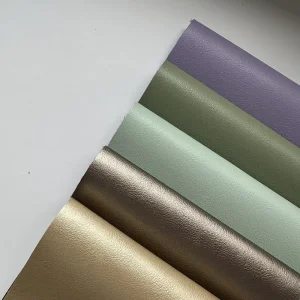
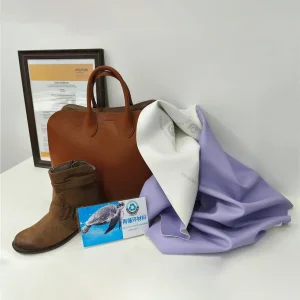
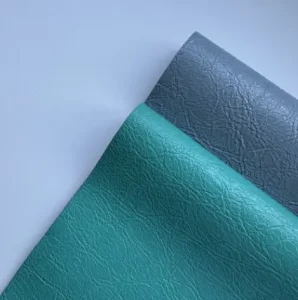
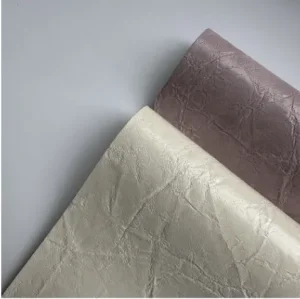
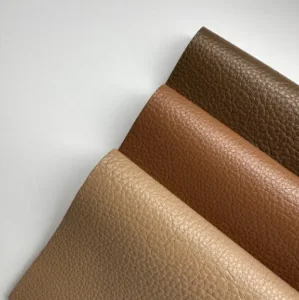
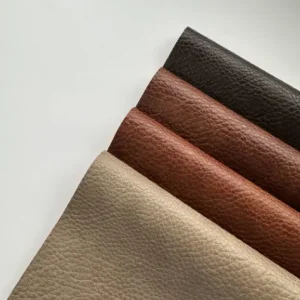
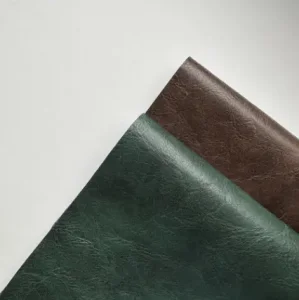
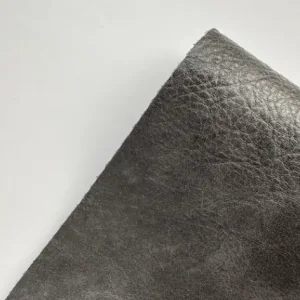
Comprehensive RCS-Certified Material References for Volume Sourcing
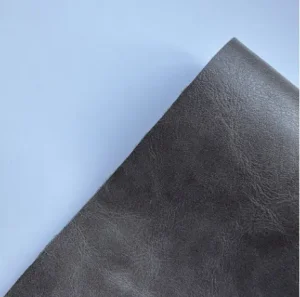
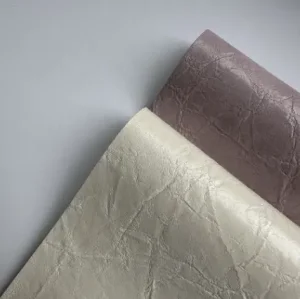
Explore custom weights, backings (woven, tricot, non-woven, microfiber), and embossings engineered to your brand’s technical sheet.


Frequently Asked Questions: Sourcing RCS Synthetic Leather in Argentina
Concrete answers covering certification chain-of-custody, minimum order quantities, sea freight protection, and payment instruments.
What is the functional difference between RCS 100 and RCS Blended certifications?
Can JiangXin issue a Transaction Certificate (TC) directly to our Argentine company?
What are the Minimum Order Quantities (MOQ) and production lead times for shipments to Argentina?
How does the material perform in Argentina's diverse climate zones (from humid Buenos Aires to arid Cuyo)?
- Hydrolysis Resistance: Formulated with advanced polyether-polyol and anti-hydrolysis crosslinking agents, passing the 7-to-10 week "Jungle Test" (70°C and 95% relative humidity), preventing the peeling and stickiness commonly triggered by humid subtropical summers in Buenos Aires and the Litoral region.
- Cold Crack Resistance: Specifically modified formulations endure down to -20°C to -30°C without surface rupture, meeting the demanding conditions required for outdoor footwear and transport gear in southern Patagonia.
- UV Resistance: Formulated with hindered amine light stabilizers (HALS) to protect against severe high-altitude solar degradation in western Cuyo and Andean regions.
Can our import broker obtain full customs dossier assistance for SEDI validation?
Accelerate Your Brand’s Circular Transition in Argentina
Request physical swatch folders, specific grain swatches, official test certificates, or wholesale container quotations. Our engineering and export team is ready to assist your technical pack requirements.