
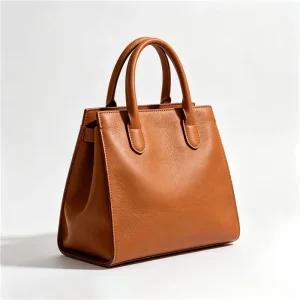
Direct Industrial Feedstock
High-Performance Eco Synthetics Available for Hamburg Distribution
Engineered for high-spec applications across maritime interior fit-outs, automotive manufacturing, and sustainable fashion hubs throughout the Elbe economic zone.
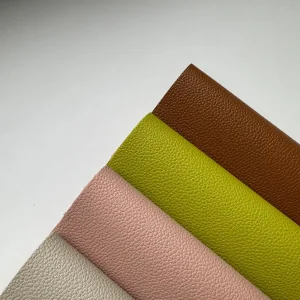
High-Quality Sustainable Eco-Friendly Faux Leather Hamburg Aerospace Spec
Explore Specifications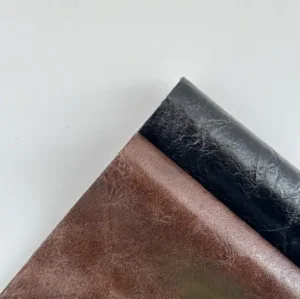
Wholesale Eco-Friendly Sustainable Synthetic Leather-0212 Port-Hub Supply
Explore Specifications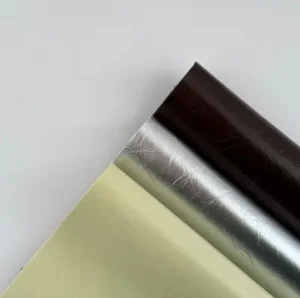
OEM Sustainable Eco-Friendly Faux Leather-0195 Northern Germany Upholstery
Explore Specifications
Regional Sourcing Dynamics
Hamburg’s Industrial Ecosystem & Sustainable Polymer Transition
Analyzing Northern Germany's shift toward circular engineering in automotive, yacht interiors, and sustainable consumer retail.
Port of Hamburg: Continental Logistics Gateway
As Europe’s third-largest container gateway, the Port of Hamburg (Hamburger Hafen) serves as a strategic crossroads for bulk deliveries. Sourcing biobased and recycled polyurethane (PU) rolls through this maritime artery slashes multi-tiered inland transport costs across DACH and Scandinavian procurement networks while optimizing Scope 3 upstream transport metrics.
Aviation & Superyacht Interior Specifications
With Hamburg being one of the world's primary civil aviation manufacturing epicenters (Finkenwerder) and luxury shipbuilding dry-docks along the Elbe, materials face stringent IMO, FAA, and FAR certification thresholds. Eco-friendly synthetic formulations must ensure self-extinguishing flame resistance, ultra-low fogging behavior, and zero halogen discharge.
Retail Decarbonization & Circular Mandates
Leading Northern European retail groups anchored in Hamburg demand verifiably circular synthetic surfaces for luggage, premium safety footwear, and consumer goods. Our water-based (WBPU) and solvent-free PU lines provide the identical luxury feel of Napa calfskin while completely cutting out toxic petrochemical solvents like DMFa and DMAC.
16M+
Meters Annual Global Output
4.68 MW
Solar PV On-Site Power
135,733 m²
Advanced Production Campus
50+
Global Export Economies
Macro Supply Chain Alignment
Resolving Enterprise ESG Tensions via Advanced Material Chemistry
How our scalable clean-tech operations neutralize regulatory risks under European sustainability directives.
Navigating Corporate Sustainability Due Diligence (CSDDD)
German corporations face unprecedented supply-chain liability under the Lieferkettensorgfaltspflichtengesetz (LkSG) and incoming EU CSDDD frameworks. Tier-1 and Tier-2 procurement leaders must eliminate environmental contamination risks at raw material origins. JiangXin manufactures all resin polymers within closed-loop dry/wet production systems running on a 4.68 MW rooftop photovoltaic matrix, backed by Higg FEM operational transparency.
Decoupling from Virgin Petroleum Feedstocks
Global brands can no longer rely on unblended fossil-fuel polyurethane coatings. Our engineering pipelines combine USDA-certified bio-content (derived from industrial non-food corn and castor beans via ASTM D6866) and post-consumer recycled substrates (RCS / GRS certified polyester fleece and microfiber). This reduces life-cycle carbon emissions by up to 48% compared to conventional PVC or solvent-borne PU leather.
R&D Milestones
Technical Roadmap: Next-Generation Artificial Leather Systems
A multi-phased engineering trajectory designed to meet 2030 circularity goals across global automotive and fashion architectures.
Phase 01: Current Production
Zero-Solvent WBPU & RCS Verification
100% water-based dispersion polyurethane, eliminating DMFa, toluene, and benzene. Full compliance with textile chain-of-custody tracking under Textile Exchange RCS.
Phase 02: Scale Execution
40%+ Bio-Based Renewable Carbons
Synthesizing polyether and polyester polyols from renewable biomass waste streams, achieving verified >40% biobased carbon according to ASTM D6866 standards without tensile penalty.
Phase 03: Deployment
Monomaterial Closed-Loop Sorting
Developing 100% single-polymer PU surfaces with matched thermoplastic polyurethane (TPU) textile backings, allowing mechanical thermal downcycling without composite delamination.
Phase 04: Horizon
Bio-Assimilable Marine Degrade Matrix
Pilot laboratory formulations combining non-toxic bio-assimilable crosslinkers, avoiding long-term microplastic persistence in marine and landfill environments.
Verification & Traceability
German & EU Compliance Assurance for Sourcing Directors
Every roll leaving our facility is certified against the world’s most stringent chemical and consumer safety benchmarks.
EU REACH SVHC & RoHS Cleared
Complete material dossiers guaranteeing the total absence of over 240 Substances of Very High Concern (SVHC) on the ECHA Candidate List, alongside full compliance with RoHS heavy-metal thresholds.
6P Phthalate-Free & OEKO-TEX Standard
Strictly non-plasticized constructions avoiding DEHP, DBP, BBP, DINP, DIDP, and DnOP. Formulated for direct cutaneous contact in footwear, apparel, and child-safe automotive passenger cabins.
Customs-Ready FOB / CIF Hamburg Delivery
Comprehensive customs declarations, certificates of origin, batch-level tensile and Martindale abrasion laboratory reports, and seamless sea-freight consignment direct to the Port of Hamburg.
Technical Knowledge Base
Frequently Asked Procurement Questions
Authoritative insights addressing chemistry, verification protocols, logistics, and customized mechanical configurations.
How do biobased synthetic leathers compare mechanically with real leather in Hamburg’s industrial climate?
Our biobased synthetic leather demonstrates superior hydrostatic resistance, flex resistance (-20°C cold-crack durability suited for North European winters), and uniform tensile strength exceeding 1.2 N/mm² without the natural hide inconsistencies of real leather. In Martindale abrasion tests, our high-tier formulations exceed 100,000 cycles, outperforming traditional automotive-grade real calfskin while remaining resistant to salt-water corrosion common in coastal port environments like Hamburg.
What exact testing methodology validates biobased vs. recycled content claims?
Biobased carbon fractions are independently verified via accelerator mass spectrometry radiocarbon dating in accordance with ASTM D6866, isolating carbon-14 isotopes of biogenic origin from fossil carbon. For recycled synthetics, chain of custody is documented from post-consumer PET bottles or industrial textile scrap via third-party Recycled Claim Standard (RCS) and Global Recycled Standard (GRS) Transaction Certificates (TCs), ensuring verifiable proof for German supply-chain compliance audits.
Can your factory support OEM automotive and aviation flame-retardant standards?
Yes. We formulate customized non-halogenated, eco-friendly flame-retardant systems that conform to automotive specifications such as FMVSS 302 and German DIN 75200. For maritime yacht interiors and public contract furniture, we calibrate resin formulations to pass British Standard BS 5852 Crib 5 and IMO FTP Code Part 8 without releasing hazardous antimony or brominated hydrocarbons.
What is the lead time and shipping pathway for direct delivery to Hamburg?
Standard OEM sampling takes 7 to 10 days upon receipt of technical grain, color, and backing specifications. Commercial bulk production runs average 15 to 21 working days. Container consignments from our Guangdong manufacturing facility reach the Port of Hamburg via standard maritime corridors in approximately 28 to 34 days, with expedited multimodal sea-rail connections available when project launch deadlines require rapid scheduling.
Are these synthetic leathers 100% free of hazardous organic solvents (DMFa/DMAC)?
Yes. Our specialized green production lines utilize advanced Water-Based Polyurethane (WBPU) dispersion chemistry and 100% solids solvent-free coating technologies. This completely eliminates volatile organic chemicals (VOCs) such as dimethylformamide (DMFa), dimethylacetamide (DMAC), and methyl ethyl ketone (MEK), fully complying with both the EU REACH Annex XVII restricted substances framework and rigorous OEKO-TEX Standard 100 Class I thresholds.
What are the minimum order quantities (MOQ) for custom color and grain matching?
Our standard MOQ for bespoke OEM production runs is 500 linear meters per color and emboss spec. We offer custom Pantone/RAL color matching, adjustable thickness profiles from 0.5mm to 2.2mm, and over 200 emboss roller profiles (including fine calf, nappa, pebble, saffiano, and custom technical micro-textures) tailored to your tech pack.
Extended Material Series
Engineered Catalog: Eco-Friendly Synthetic Formulations for Industrial Sourcing
Explore specialized technical articles spanning bio-polyols, traceable recycled substrates, and low-carbon PU composites.
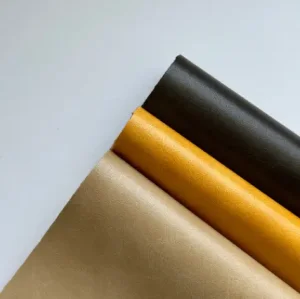
Custom Eco-Friendly Sustainable Synthetic Leather-0251 Hamburg Spec
Explore Specifications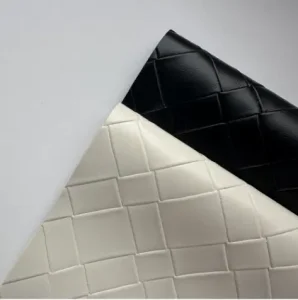
Custom Green Sustainable Man-Made Leather-9338 Elbe Series
Explore Specifications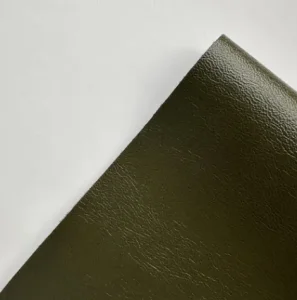
Custom Eco-Friendly Sustainable Synthetic Leather-0230 Low-VOC System
Explore Specifications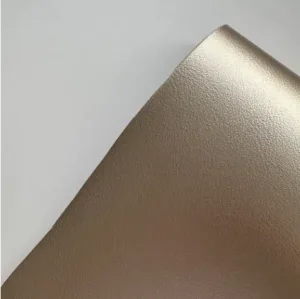
High-Quality Eco-Friendly Sustainable Synthetic Leather-9081 DACH Line
Explore Specifications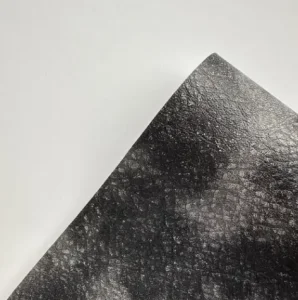
Wholesale Low-Carbon Eco Sustainable Synthetic Leather-0045 Cargo Standard
Explore Specifications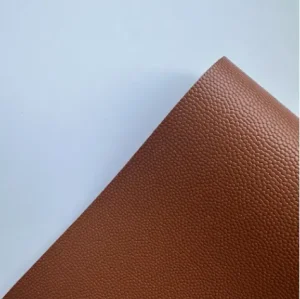
Wholesale Sustainable Eco-Conscious Synthetic Leather-9142 Fashion Tier
Explore Specifications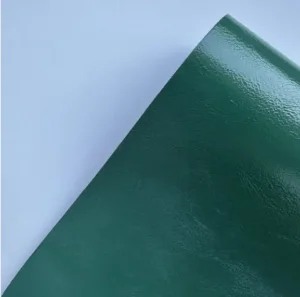
High-Quality Low‑Impact Green Sustainable Synthetic Leather-9333 Technical Grain
Explore Specifications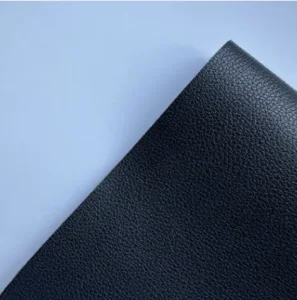
High-Quality Green Low‑Carbon Sustainable Synthetic Leather-9077 Marine Master
Explore SpecificationsAccelerate Your Low-Carbon Supply Transition Today
Request bespoke physical sample swatches, review verified ASTM D6866 bio-content and RCS audit certificates, or schedule a technical session with our chemical engineering team.
Send Inquiry Now